Guides
3M 467MP vs 468MP: Which Adhesive Transfer Tape Do You Need?

By Neil Sinclair, Product Development Engineer at RGH Converting.
Published 27 November 2026 · Last updated 27 November 2026
3M 467MP and 468MP use the same high-performance acrylic adhesive, 3M Adhesive 200MP, on the same paper liner. The difference is thickness: 467MP carries 0.06 mm of adhesive and 468MP carries 0.13 mm, a little over twice as much. That single difference decides which surfaces each one bonds well, how much peel strength you get, and how the bond line looks.
The short answer: choose 467MP when both surfaces are smooth and a thin bond line matters. Choose 468MP when either surface has a texture you can see or feel, or when you need more peel strength. The rest of this guide shows why, with 3M's own data, and covers the cases where neither is the right tape.


What is an adhesive transfer tape?
An adhesive transfer tape is pure adhesive on a release liner, with no carrier film in the middle. You apply it to one part, peel the liner away, and bond the second part to the exposed adhesive. With nothing but adhesive in the joint, you get the thinnest, cleanest bond line available from a tape, and nothing inside it that could split or delaminate.
A double-coated tape is different: adhesive on both sides of a thin film or tissue carrier. The carrier adds body, which makes very thin or very small parts easier to handle and die-cut, at the cost of a slightly thicker joint. If your parts are flimsy or tiny, that trade can be worth making; ask us and we will tell you which suits your design.
467MP vs 468MP side by side
| Property | 3M 467MP | 3M 468MP |
|---|---|---|
| Adhesive | 3M Adhesive 200MP (high-performance acrylic) | 3M Adhesive 200MP (high-performance acrylic) |
| Adhesive thickness | 0.06 mm (2.3 mil) | 0.13 mm (5.2 mil) |
| Podszewka | Poly-coated kraft paper, 0.11 mm | Poly-coated kraft paper, 0.11 mm |
| Peel to stainless steel, 90°, after 72 hours | 26 N/25 mm | 30 N/25 mm |
| Peel to stainless steel, 180°, after 72 hours | 21 N/25 mm | 39 N/25 mm |
| Peel to glass, 90°, after 72 hours | 25 N/25 mm | 31 N/25 mm |
| Peel to polycarbonate, 90°, after 72 hours | 20 N/25 mm | 24 N/25 mm |
| Peel to aluminium, 90°, after 72 hours | 18 N/25 mm | 23 N/25 mm |
| Short-term temperature (minutes to hours) | Up to 204°C | Up to 204°C |
| Long-term temperature (days to weeks) | Up to 149°C | Up to 149°C |
| Lowest service temperature | −40°C | −40°C |
| Best on | Smooth surfaces; thin, flexible materials | Textured surfaces; where more peel strength is needed |
Typical values from 3M's technical data for adhesive 200MP transfer tapes (peel tested to ASTM D3330, modified). Not for specification purposes; always confirm against the current 3M datasheet for 467MP or 468MP.
Two things stand out. First, 468MP is ahead in every peel test 3M publishes, on every surface, and the gap is widest in the 180° peel. Second, the extra adhesive pays off after exposure too: in 3M's environmental testing, 468MP kept noticeably more of its peel strength after salt water, high humidity and 2,000 hours of UV than 467MP did.
Which one should you choose?
Choose 467MP when
- Both surfaces are smooth. Metal nameplates onto smooth panels, polyester and polycarbonate overlays, membrane switch layers.
- The bond line has to be thin. Tight stack heights, or an edge that must not show.
- You are laminating thin, flexible materials where extra adhesive would add bulk without adding performance.
Choose 468MP when
- Either surface has a texture you can see or feel. 3M's own guidance is that if a texture is visible on one or both surfaces, the thicker adhesive is the one to use. The extra adhesive flows into the texture and makes contact where 467MP would bridge across it.
- You need more peel strength, on any substrate.
- The joint will see moisture, salt, humidity or UV over its life, where 468MP's better retention matters.
Choose neither when
- One surface is a low surface energy plastic such as polypropylene, polyethylene, TPO or many powder coatings. Adhesive 200MP is not designed for these. Use the 300LSE family instead: 3M 9471LE for smoother surfaces or 9472LE for textured ones.
- You are bonding two rigid parts that are not perfectly flat, or that expand at different rates with temperature. A transfer tape is too thin to take up the gap or the movement. That is a job for an acrylic foam tape; see our 3M VHB tape guide.
Where 467MP and 468MP are used
Both grades are long-standing workhorses for permanent bonding to metals and high surface energy plastics. Typical applications include:
- Graphic overlays and membrane switch assemblies on equipment panels
- Metal nameplates, rating plates and badges, including subsurface-printed transparent overlays
- Component and label bonding in electronics, telecoms and medical devices, where the layflat liner suits high-speed processing
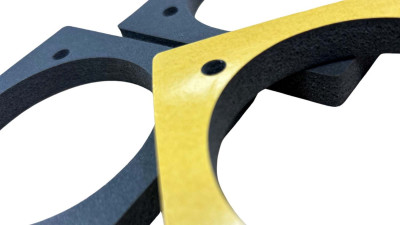
- Laminating foams and other materials to give them a self-adhesive face before they are die-cut into gaskets and pads
The temperature and solvent resistance of adhesive 200MP is why they also turn up in automotive and harsh industrial settings: short exposures up to 204°C, and bonds that hold up to oils, fuel splash and mild acids and alkalis.
Getting the bond right
Most transfer tape failures come down to the surface, not the tape. 3M's application guidance is straightforward:
- Clean and dry both surfaces. Isopropyl alcohol suits most plastics; heptane removes oil from metals. Use reagent-grade solvents, not household rubbing alcohol, which can contain oils that weaken the bond.
- Apply in the right temperature range. Roughly 16°C to 38°C is ideal. Below 10°C the adhesive becomes too firm to flow into the surface.
- Press firmly and evenly across the whole part. Contact is everything with a thin adhesive; 3M suggests 10 to 15 psi (roughly 0.7 to 1 bar) of final pressure.
- Give it time. Bond strength builds as the adhesive wets out. In 3M's testing, 467MP's peel to stainless steel nearly doubles between 15 minutes and 72 hours. Heat speeds this up on metal.
Formats: sheets, slit rolls and die-cut parts
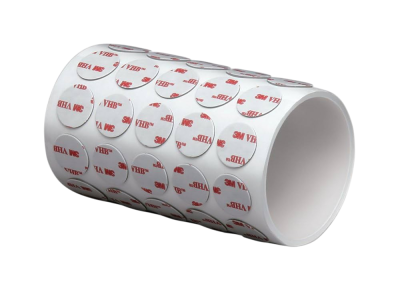
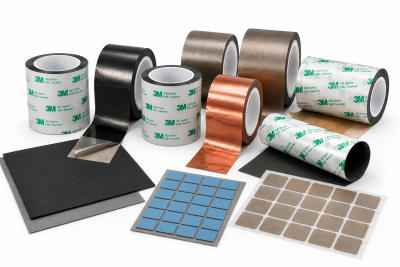
As a Preferowany przetwórca 3M, we supply and convert 467MP and 468MP in the format your process needs: sheets, rolls slit to the width you specify, or die-cut parts kiss-cut on the liner, ready to peel and place. The poly-coated kraft liner is part of why both grades convert so cleanly: it lies flat and resists curling in humid conditions, so parts stay where they should on the line.
Frequently Asked Questions
3M 467MP vs 468MP FAQs
-
What is the difference between 3M 467MP and 468MP?
Thickness. Both use 3M Adhesive 200MP on a poly-coated kraft liner, but 467MP has 0.06 mm of adhesive and 468MP has 0.13 mm. 467MP suits smooth surfaces and thin bond lines; 468MP suits textured surfaces and gives higher peel strength.
-
Is 468MP stronger than 467MP?
In peel, yes. In 3M's published testing 468MP is ahead on every substrate: for example 39 N/25 mm against 21 N/25 mm in a 180° peel from stainless steel after 72 hours. It also retains more of its strength after humidity, salt water and UV exposure.
-
What temperature can 467MP and 468MP withstand?
Both are rated by 3M up to 204°C for short exposures of minutes to hours, up to 149°C for long-term exposure of days to weeks, and down to -40°C.
-
What is 3M Adhesive 200MP?
3M's high-performance acrylic adhesive family, designed for strong, permanent bonds to metals and high surface energy plastics, with good resistance to heat, humidity, solvents and UV. It is the adhesive in both 467MP and 468MP.
-
Will 467MP stick to polypropylene?
Not reliably. Polypropylene and polyethylene are low surface energy plastics, and adhesive 200MP is not designed for them. 3M's 300LSE adhesive family, in tapes such as 9471LE and 9472LE, is the better choice.
-
What is the difference between transfer tape and double-sided tape?
A transfer tape is adhesive only, on a release liner, with no carrier. A double-sided (double-coated) tape has adhesive on both sides of a film or tissue carrier. Transfer tape gives a thinner, cleaner bond line; the carrier in a double-coated tape makes small or thin parts easier to handle.
-
How long does 468MP take to reach full strength?
Bond strength builds as the adhesive flows into both surfaces. You get usable strength straight away, and around 72 hours at room temperature for full strength. Warmth speeds this up, particularly on metal.
Not sure which grade? Send us the two surfaces
Tell us what you are bonding to what, and the environment it has to survive. Our team will recommend the grade, whether 467MP, 468MP or something better suited, and quote it in the format you need, from slit rolls to die-cut parts.