By Neil Sinclair, Product Development Engineer at RGH Converting.
Published 9 September 2026 · Last updated 9 September 2026
3M™ VHB™ tape is a double-sided acrylic foam tape engineered to replace rivets, welds, screws and liquid adhesives in structural bonding. VHB stands for Very High Bond, and the name is not marketing: the strongest grades in the range carry extensive loads permanently, in exterior conditions, on assemblies that will never be taken apart. This guide explains how the tape achieves that, which grade suits which job, and the application details that decide whether a VHB bond performs or disappoints.
How VHB tape works
The tape is a solid acrylic foam, adhesive the whole way through rather than adhesive coated onto a carrier. That construction gives it three properties a fastener does not have.
- It spreads load instead of concentrating it. A rivet carries the entire load at one point, which is where fatigue cracks start. A VHB bond line distributes stress along its whole length, so the joint is often stronger in practice than the sum of the fasteners it replaced.
- It is viscoelastic, so it absorbs movement. The foam core flexes under vibration and accommodates the different rates at which two bonded materials expand and contract with temperature. That is why it suits panel bonding on vehicles and buildings, where a rigid joint would eventually fail.
- It seals while it bonds. A continuous bond line is also a continuous gasket, which removes the water ingress path that every drilled hole creates.
The bond also builds over time rather than arriving instantly. Handling strength is immediate, but the adhesive continues to flow into the microscopic texture of both surfaces for around 72 hours, and ultimate strength is reached at the end of that period. Design your process around that: assemble, then let the joint rest before it is loaded or transported.
Which VHB grade do you need?
The range splits by what you are bonding to and how much movement or load the joint sees. These are the grades we stock and convert; specifications are typical values from 3M, not for specification purposes.
| Grade | Thickness | Character | Typical use |
|---|---|---|---|
| VHB Max-Series | 0.6 mm, 1.1 mm, 1.6 mm, 2.3 mm | The strongest in the portfolio: two to three times the shear and tensile strength of standard VHB, used with Max Promoter. 121°C long term, 180°C short term | Structural bonding where a standard grade is not enough; narrower bond lines for the same strength |
| VHB GPH-Series | 0.6 mm, 1.1 mm, 1.6 mm | General purpose high temperature; the workhorse for hot processes and paint bake | Panel bonding where the assembly passes through heat after bonding |
| VHB LVO-Series | 0.6 mm, 1.1 mm, 1.6 mm | Low volatile organic compound formulation | Interior and cabin applications with air quality requirements |
| VHB 5952 | 1.1 mm | Conformable general purpose, black; the most widely specified VHB grade | Metal, glass and high surface energy plastics across most industries |
| VHB 5909F | 0.3 mm | Thin VHB where a thick bond line will not fit | Tight stack heights that still need VHB performance |
| VHB transfer tapes F9460PC, F9469PC, F9473PC | 0.05 mm to 0.25 mm | VHB adhesive without the foam core, on a liner | Bonding rigid, flat, well-matched surfaces where no gap filling is needed |
Thicknesses and characteristics are typical of each family. Surface energy, temperature rating and cure time vary by grade – confirm against the specific 3M datasheet before specifying.
Two rules cover most selection decisions. First, thicker bond lines handle more differential movement, so if the two materials expand at different rates or the surfaces are not perfectly flat, go thicker rather than thinner. Second, surface energy decides everything: metals, glass and painted surfaces can bond readily, while low surface energy plastics like polypropylene and polyethylene need either a grade specified for them or a primer. If you are unsure which camp your substrate falls into, that is exactly the question to send us with a sample.
When VHB is the right answer, and when it is not
VHB earns its place when you are bonding dissimilar materials that cannot be welded, when you want a smooth exterior with no visible fixings, when the joint must absorb vibration or thermal movement, or when drilling would compromise the part. Commercial vehicle panels, architectural facade components, appliance trim, display assemblies and signage are all classic applications.
It is the wrong answer in a few situations, and it is worth being straight about them. VHB needs a reasonable bond area, so an extremely small tab carrying a heavy load is a poor fit, although VHB-Max may be suitable. It struggles on some untreated low surface energy plastics, untreated silicone surfaces and anything oily, dusty or freshly painted that has not fully cured. It is designed to be permanent, so if the assembly must be serviced or dismantled, a mechanical fastener or a reclosable system will serve you better such as Dual-Lock. And it needs a minimum application temperature (minimum of around 10 degrees C), so bonding in an unheated workshop in winter will disappoint you.
Getting the application right
Most disappointing VHB bonds are application problems, not material problems. Four things matter:
- Clean properly. An isopropyl alcohol and water mix removes the oils and release agents that stop wet-out. Let it flash off completely before bonding. 3M VHB Surface Cleaner is ideal for most applications.
- Apply firm pressure. The adhesive is pressure-activated. Roller or press pressure across the whole bond line does more for final strength than any other single step. VHB Max requires more pressure than other VHB tapes.
- Watch the temperature. Bond in a warm environment. Cold surfaces slow the adhesive's ability to wet out, and a bond made cold rarely recovers.
- Respect the dwell. Handling strength is immediate; full strength takes around 72 hours. Do not load or ship the assembly straight off the line if you can avoid it.
VHB supplied as die-cut parts
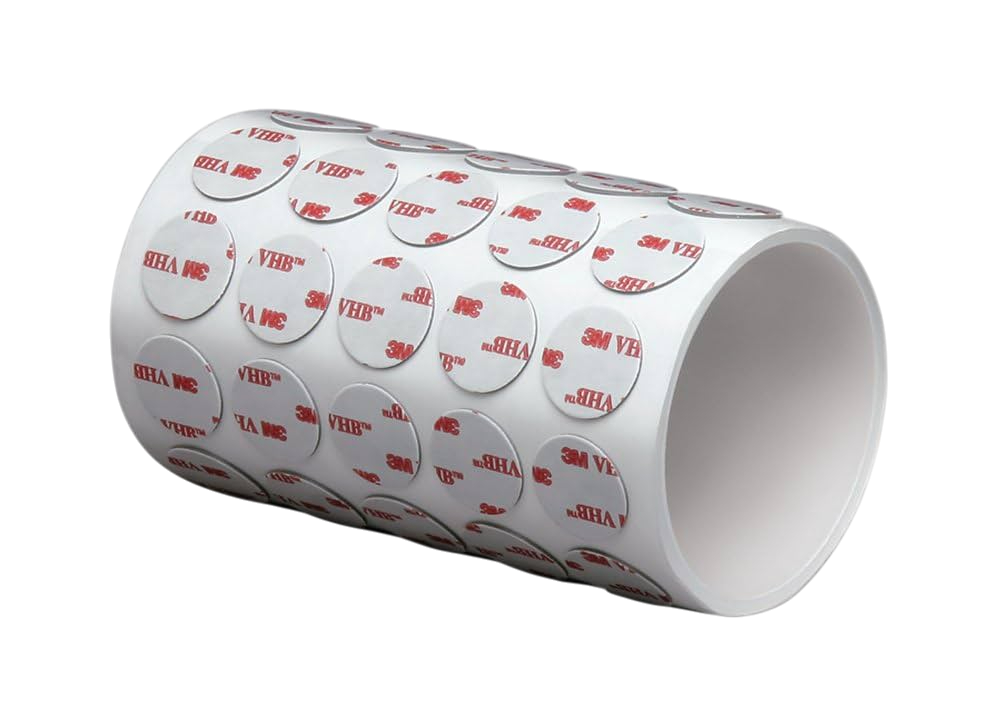
Very little VHB is applied from the roll in production. As a 3M™ Preferred Converter, we supply it as die-cut gaskets, pads, strips and frames matched to your part, with extended pull tabs where the operator needs to position the piece before committing it, and in the format your line handles best: individual parts, sheeted layouts, or kiss-cut on a continuous roll.
Converting VHB well takes some care. It is thick, aggressive and unforgiving of a poorly chosen liner, so we discuss and trial the format before production rather than assuming a standard. Rotary and flat-bed die-cutting cover the geometry, and everything runs under our ISO and IATF 16949 quality systems. Learn more about IATF 16949 here.
Frequently Asked Questions
3M VHB Tape FAQs
-
What is VHB tape?
VHB stands for Very High Bond. It is a double-sided acrylic foam tape from 3M, adhesive throughout rather than coated onto a carrier, designed for extreme bonding in place of rivets, welds, screws and liquid adhesives.
-
How strong is 3M VHB tape, and how much weight can it hold?
Strength depends on bond area, grade, substrate and the direction of the load, so there is no single weight figure. What matters is that load is calculated across the whole bond area rather than per piece: a long bond line carries far more than a small pad of the same tape. Shear loads (sliding along the joint) are handled better than peel loads (lifting one edge), which is why joint design matters as much as grade selection. Send us the load, the substrates and the geometry and we will size it with you.
-
How long does VHB tape take to cure?
VHB does not cure chemically; it builds strength as the adhesive wets out into both surfaces. You get handling strength immediately, most of the final strength within the first day, and ultimate strength after about 72 hours at room temperature. Warmer conditions speed the process up, cold slows it down.
-
How long does VHB tape last?
Acrylic VHB bonds are designed to be permanent and hold up well outdoors, resisting UV, moisture and temperature cycling. They have been used in construction and transport for decades on assemblies expected to last the life of the structure or vehicle. Actual service life depends on the substrates, the loads and the environment, so validate on your own assembly.
-
How thick is VHB tape?
The foam grades commonly range between 0.3mm and 2.3mm, and the VHB transfer tapes come much thinner at roughly 0.05 to 0.25 mm. Thicker bond lines absorb more differential movement between materials; thinner ones suit rigid, well-matched surfaces where nothing needs to flex.
-
How do you apply 3M VHB tape?
Clean both surfaces with an isopropyl alcohol and water mix or 3M VHB Surface Cleaner and let them dry. Apply the tape to one surface, remove the liner, position the parts, then apply even pressure firmly across the entire bond line. Work in a warm environment, and leave the joint to build strength before loading it.
-
How do you remove 3M VHB tape?
The usual method is to cut through the foam core with a strong wire or cutting line worked along the bond, then remove the residue left on each surface with heat and an adhesive remover, working slowly to avoid damaging the substrate. It is deliberately difficult, because the tape is designed as a permanent fixing. If you expect to need to dismantle the assembly, a reclosable fastener such as Dual-Lock is the better specification.
-
Does VHB tape work on plastic?
It depends on the plastic. High surface energy plastics such as ABS, polycarbonate and PET bond well. Low surface energy plastics such as polypropylene, polyethylene and PTFE resist adhesion and need either a grade formulated for LSE substrates or an adhesion promoter. Testing on your actual material is always worth the sample request.
Talk it through, or get samples cut to your drawing
If you are weighing VHB against fasteners on a live design, send us the substrates, the loads and the environment and our technical team will recommend a grade, flag anything that needs a primer, and cut trial parts to your drawing so you can test the joint before you commit.