Guides
Thermal Tape Selection Guide: How to Choose the Right Thermally Conductive Tape

By John Castle, Electronics and EMC Specialist at RGH Converting.
Published 14 July 2026 · Last updated 9 September 2026
Thermal tape (thermally conductive tape) is a pressure-sensitive adhesive tape filled with ceramic particles that carries heat away from electronic components while bonding them to a heat sink or spreader, replacing mechanical fasteners, clips and liquid adhesives in one step.
It is the practical choice when you need a thermal interface material that also holds the assembly together: 3M's thermally conductive tapes deliver conductivity from 0.6 to 1.5 W/m·K in thicknesses from 0.1 mm to 0.5 mm, with dielectric strength up to 26 kV/mm.
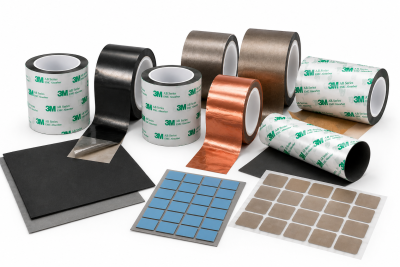
This guide compares the 3M™ thermally conductive tape range spec by spec, explains which numbers actually matter when you select one, and shows how RGH supplies these materials as ready-to-place die-cut thermal pads, including the converting decisions that matter with a material this delicate.
Thermal tape vs. thermal paste vs. thermal pads
All three are thermal interface materials (TIMs): they fill the microscopic air gaps between a hot component and its cooling surface. Air is a poor conductor at roughly 0.03 W/m·K, so even a modest TIM transforms heat transfer. The right choice depends on whether you also need the joint to carry mechanical load:
| Property | Thermal Tape | Thermal Paste | Gap Pads |
|---|---|---|---|
| Bonds the joint | Yes — replaces fasteners | No — needs clamping | No — needs clamping |
| Typical conductivity | 0.6–1.5 W/m·K | 1–8 W/m·K | 1–6 W/m·K |
| Assembly speed | Peel-and-stick, die-cut to shape | Manual dispensing, messy | Place and clamp |
| Best when | Component has no mounting points; automated assembly | Extreme heat loads with existing clamping | Large tolerance gaps |
If your component already has screws or clips, paste or pads may edge it on raw conductivity. If it does not (an LED module on a housing, say, or a driver IC on a spreader plate), thermal tape does both jobs and removes a fastening operation from your line.
The five specs that matter (and the one that is overrated)
- Thermal impedance, not just conductivity. Conductivity (W/m·K) is a bulk material property; impedance (°C·cm²/W) measures resistance across the actual joint at a given thickness. A thinner 0.6 W/m·K tape often outperforms a thicker 1.5 W/m·K one: 3M's 0.125 mm 8805 has lower impedance (3.2 °C·cm²/W) than its 0.5 mm 8820 sibling (9.7) despite identical conductivity. Always compare impedance at your gap thickness.
- Thickness and gap filling. The tape must fully wet out both surfaces. Smooth, flat mating surfaces suit 0.1 to 0.2 mm tapes; rougher or slightly uneven surfaces need 0.25 to 0.5 mm to conform.
- Dielectric strength. Most thermally conductive tapes are electrically insulating; ceramic fillers conduct heat, not current. Grades range from 15 to 26 kV/mm, which matters when the tape sits between live components and a grounded heat sink.
- Adhesion and shear at temperature. Acrylic adhesives in this family typically operate up to around 90°C continuously. Check peel values at your operating temperature, not just room temperature, and remember the bond is also carrying the component's weight through vibration.
- UL 94 flammability. The 8711, 8708 and 8926 series carry UL 94 V-0 ratings (per UL file QMFZ2.E239181), often a hard requirement in enclosed electronics.
- The overrated one: headline W/m·K. Datasheet conductivity is measured on the bulk material under ideal lab conditions. Joint design, applied pressure and surface preparation routinely swamp a two-times difference in the headline figure.
The 3M thermally conductive tape range compared
Representative values from the 3M Thermally Conductive Interface Tapes selection guide. Not for specification purposes: confirm against the individual product datasheet.
| Product | Thickness (mm) | Conductivity (W/m·K) | Impedance (°C·cm²/W) | Dielectric (kV/mm) | UL 94 |
|---|---|---|---|---|---|
| 8711-100 | 0.10 | 0.6 | n/a | 26 | V-0 |
| 8708-025 | 0.25 | 0.6 | n/a | 15 | V-0 |
| 8926-02 | 0.20 | 1.5 | 8.49 | 15 | V-0 |
| 8926-025 | 0.25 | 1.5 | 8.74 | 15 | V-0 |
| 8926-05 | 0.50 | 1.5 | 9.70 | 15 | V-0 |
| 8805 | 0.125 | 0.6 | 3.2 | 26* | n/a |
| 8810 | 0.25 | 0.6 | 5.8 | 26* | n/a |
| 8815 | 0.375 | 0.6 | 7.7 | 26* | n/a |
| 8820 | 0.50 | 0.6 | 9.7 | 26* | n/a |
| 9876-10 (heat spreading) | 0.10 | >250 X-Y / 0.8 Z | 1.93 | 29 | n/a |
* Dielectric strength — refer to the product datasheet for test conditions.
How to read the range: the 8805 to 8820 transfer tapes are the workhorses. Pure adhesive with ceramic filler and no carrier, they wet out well on rough or low-surface-energy substrates and come in four thicknesses to match your gap. The 8926 series adds a thin PET carrier for easier handling, reworkability and the highest conductivity in the family at 1.5 W/m·K. The 8711-100 is the thin, economical option where the gap is minimal. And the 9876-10 heat spreading tape is a different tool entirely: a copper-layer tape that moves heat sideways (over 250 W/m·K in-plane) to spread hot spots across a surface rather than through a joint.
Matching tape to application
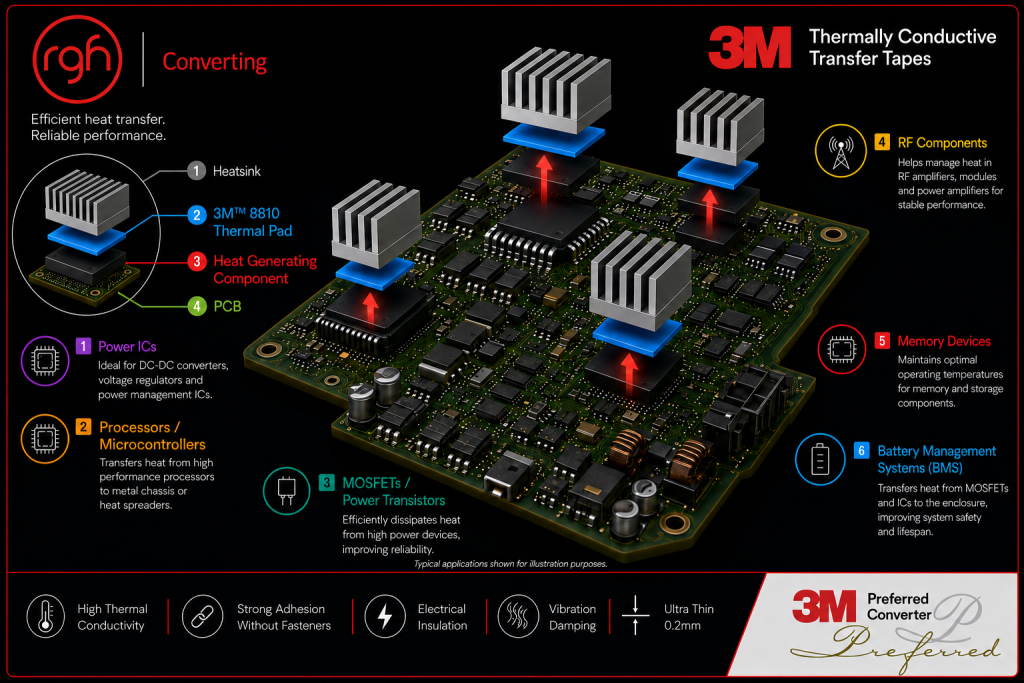
- LED lighting: bonding LED modules and drivers to housings. The 8926 series suits output-critical fixtures; 8805 and 8810 suit general luminaires.
- Power electronics and EV battery systems: heat-generating ICs, MOSFETs and voltage regulators bonded to spreaders, and battery management systems where pads carry heat from cell-monitoring boards to the enclosure. Dielectric strength is usually the deciding spec.
- Automotive ECUs and sensors: vibration resistance matters as much as conductivity here, and the soft acrylics in this family damp vibration while they cool.
- RF and communications equipment: managing heat in RF amplifiers and modules, and compact assemblies where a 0.1 to 0.2 mm tape replaces a clip-plus-pad combination and shaves height off the stack.
Applying thermal tape correctly
Getting the application right matters more than picking between adjacent grades. These are the fundamentals from 3M's guidance, plus the handling points that matter once the material arrives as die-cut pads:
- Surface preparation. Clean with isopropyl alcohol and let it flash off completely. Fingerprints and mould-release residues are the leading cause of poor wet-out.
- Pressure, not time. These acrylics are pressure-activated: apply firm, even pressure with a roller or press, not thumbs, to drive the adhesive into the surface microstructure. Wet-out visibly improves adhesion and thermal contact.
- Dwell. Peel values in the 3M guide are quoted at 72-hour dwell, so expect bond strength to build over the first days. Design your process so the assembly is not stressed immediately.
- Rework. Carrier-backed grades (the 8926 series) can be removed and repositioned during assembly; transfer tapes generally cannot. If your line needs rework tolerance, that decides the family before any thermal spec does.
Die-cut thermal pads, supplied in the format your line needs
Very few production lines use thermal tape off the roll. As a 3M™ Preferred Converter, and winner of the 3M Converter Cup 2025, RGH Converting supplies 3M thermally conductive tapes as precision kiss-cut pads on continuous rolls, sheeted parts, or custom formats matched exactly to your component footprint.
Heat is rarely the only thing an enclosure has to manage. Our EMI shielding guide covers interference, and our guide to specifying a foam gasket covers environmental sealing.
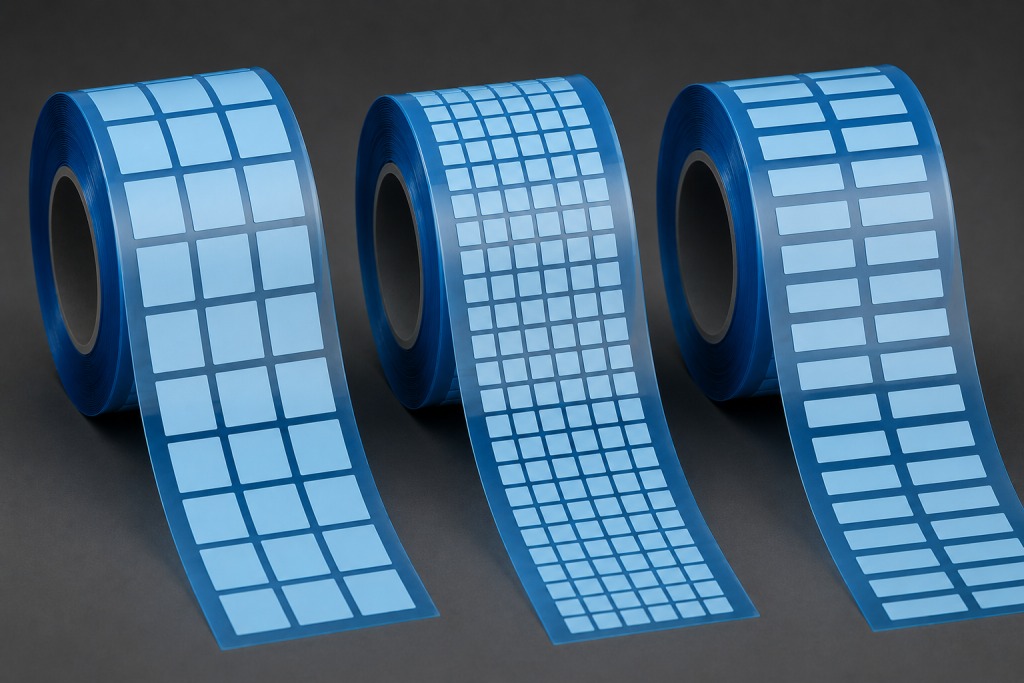
Thermally conductive tapes are softer and more delicate than standard PSA tapes, so the converting decisions matter as much as the grade selection. Liner choice and presentation format determine how cleanly each pad releases, how well it survives handling, and how quickly your operators or automated feed can place it. That is why we always discuss and trial the format with each client before production rather than assuming a standard: kiss-cut pads on a roll for fast repeat placement, sheeted parts for manual assembly, or a supported liner arrangement where the material needs extra protection.
- Kiss-cut pads on a continuous liner, in square, rectangular or fully custom shapes
- Format and liner trials with your parts before you commit to production
- Rotary and flat-bed die-cutting for complex geometries, holes and registration features
- Prototyping through to production supply, backed by four decades of adhesive tape converting
Frequently Asked Questions
Thermal Tape Selection FAQs
-
What is thermal tape used for?
Thermal tape bonds heat-generating electronic components (LEDs, power ICs, sensors) to heat sinks, spreaders or housings while conducting heat across the joint. It replaces mechanical fasteners and separate thermal interface materials in one peel-and-stick step.
-
Does thermal tape actually work?
Yes, within its design envelope. Filled acrylic tapes conduct 0.6 to 1.5 W/m·K, a 20 to 50 times improvement over the air gap they replace. For extreme heat loads with existing clamping, paste can outperform tape; where the tape must also hold the part, it is usually the better system choice.
-
Is thermal tape electrically conductive?
No. Standard thermally conductive tapes use ceramic fillers that conduct heat but insulate electrically, with dielectric strengths of 15 to 26 kV/mm. 3M's 9876 heat spreading tape, built on a copper layer, is the exception; check before using it near live circuits.
-
Is Kapton (polyimide) tape thermally conductive?
Not meaningfully. Standard polyimide tape is an electrical insulator with low thermal conductivity (roughly 0.2 W/m·K) and is used for masking and electrical insulation, not heat transfer. For thermal joints, use a purpose-filled thermally conductive tape.
-
How do you apply thermal tape?
Clean both surfaces with isopropyl alcohol, position the die-cut pad, and apply firm, even pressure with a roller or press. Full bond strength builds over about 72 hours, so avoid stressing the joint immediately after assembly.
-
Can thermal tape be removed?
Carrier-backed grades like the 3M 8926 series are designed to be reworkable during assembly. Transfer tapes (8805 to 8820) form a permanent bond; removal requires mechanical peeling and solvent cleaning of residue.
Get the guide, or trial the format on your parts
Download the full 3M Thermally Conductive Interface Tapes selection guide, or send us your component drawing and application details. Our technical team will recommend a grade, then trial the pad format and liner with you so you can validate both the thermal performance and the handling on your real assembly.
So you've narrowed down the right tape and landed on 3M VHB, but what thickness do you need?
Alternatively, check out some more articles by John Castle like our EMI and RFI Shielding Guide.
Request Die-Cut Samples
Test the fit before you commit. Samples cut to your drawing.